John Small, a fourteen year old boy in Uptown St. Paul, proceeds into the Suburban World Cinema, anxious to see Abel Ferrara's Bad Lieutenant. He is equipped with a parental note, replete with the phone number where his parents can be reached to verify that they did indeed author the note should its authenticity be questioned. John pushes seven crumpled-up dollar bills and the folded note into the metal dugout under the box office window, only to be met with a tinny, disinterested voice booming through the round silver speaker mounted on the window: "No children under seventeen allowed! Sorry. This note isn't gonna cut it."
The incident exemplifies a pressing issue in the ever-topical discussion of the oft-vilified film rating classification system in our country. Is the movie rating system, originally designed to assist parents in guiding the movie-going habits of their children, actually preempting parental choice?
To at least some people, however, Jack Valenti, the man responsible for devising the Motion Picture Association of America and the National Association of Theatre Owners, is leading the effort, as editorialist James Wall put it, "to protect children" (1227). Valenti wrote, "The voluntary Movie Rating System has one objective: to issue advance cautionary warnings to parents so they can make their own decisions about what movies their children should or should not see. No one -- appointed, anointed, or elected -- ought to insert themselves into individual parental decisions" (87). But the film classification system, designed to assist parents in making decisions about their offspring's film patronage, often thwarts that very purpose and, in the process, actually stifles the creativity and honesty of the film industry as well.
Although Valenti and the Rating System's advocates claim that parents should have the final choice in what their children view, the system may, in practice, obstruct that purpose for parents who decide that their children should see some films. For films with the controversial NC-17 rating, the theatre is prevented from letting young John Small and his under-aged ilk from seeing a film despite his parents' permission. In fact, had John actually been accompanied by his parents, the theatre would have had every right -- some would even say responsibility -- to refuse his admission. The printing of the NC-17 rating often does not read -- as would be reasonable -- "Intended for Adults Only" but rather the more rigid "Not to be Attended by Children Under Seventeen."
The NC-17 rating -- the current classification for films containing "adult" content and themes -- was invented to assuage the difficulties that became epidemic since the adult film industry discovered that the ratings board had never patented the X rating and made the "X" synonymous in the common American lexicon with hard-core depictions of sex. As critic Richard Corliss explains, "The idea was to remove the stigma of pornography that the X rating bore and allow serious filmmakers to explore provocative styles without worrying that the parents of a 14-year-old might be offended" (64). NC-17 was supposed to assist parental decision-making. But the entry-prohibiting power of NC-17 places the decision in the hands of the theatre owner, not the parent or guardian. Far from advisory, the NC-17 rating is regulatory.
The regulatory nature of the NC-17 could be argued to assist parents by giving a supportive voice to their disapproval (assuming they disapprove their child's seeing the film, of course). But the system itself is inconsistent. Other ratings -- G and PG, particularly -- are not regulatory. Suppose John Small were the progeny of parents who believe that all profanity and depictions of sex and violence, however "tame," are unconscionable. They would forbid John from seeing PG and PG-13 films. But, as he is fourteen years old, John would not be turned away from the box office, even without a note. In the case of NC-17 films, the cashier is expected to act in loco parentis, no matter what the parents' actual wishes may be. In the cases of other ratings, parental wishes are not even consulted. In the first instance, a parental decision that a child is mature enough to see Bad Lieutenant is overruled; in the latter, the parents' desire to keep their fourteen year old from seeing a PG-13 film is inconsequential. The subjectivity of any rating system in a creative industry calls this inconsistency of implementation and authority into question. And who is making these powerful ratings decisions? The ratings board consists of twelve members chosen by Valenti and the board's chair (also chosen by Valenti) to serve voluntary two to five year terms. Information about this cabal has traditionally been closely guarded. Nonetheless, a few details have managed to slip out. "All the board's current members are between 35 and 74, all are parents [The seventy-four year old has children who would be affected by ratings?], and all live in California" (Svetkey 30). None of these individuals is affiliated with the entertainment industry.
For twenty years, the ratings board's chief counter of pudendums, foul utterances, explosions, and various mutations was Richard Heffner, routinely described as one of the most powerful men in Hollywood because some of filmdom's most legendary contemporary artists have had to trim their creations to meet his demands. According to Time magazine, Heffner has retired, giving way to replacement Richard Mosk who, in a single month's time, has slapped two Miramax films with the NC-17 rating. "On the basis of these decisions, the Heffner era may soon be regarded as the age of the enlightenment" (Time 68).
However helpful -- even noble -- it is for parents to classify films for other parents, the board as it currently exists is a venue in which the judgments of a small, non-representative sampling of individuals is intended to represent the judgment of an entire nation of parents. Yet no one would dispute that children differ greatly in degrees of maturity and sensitivity or that families differ equally significantly in their values and in their approaches to achieving those values. Even if the issue of NC-17's regulatory power were laid aside, the one or two-letter label is hardly sufficient information for parental decision-making. A film like Bad Lieutenant, however shocking or controversial, does offer a moral message and a springboard for discussion that may, in the judgment of some parents, outweigh the depictions of "offensive" behavior which ultimately determined its rating. On the other hand, The Adventures of Huckleberry Finn, however wholesome, does contain a scene between Huck and his "Pap" which might not be, in the judgment of a parent, a good experience for a recent victim of child abuse at this time. The NC-17, R, PG, or even G label does not contain sufficient information for making informed decisions.
But the ineffectiveness of its efforts to assist parents is not the only problem with the rating system. In addition, the system forces artists to ride a frustrating merry-go-round on which they are encouraged by "money men" to adjust their works, sometimes needing to resubmit a film numerous times until they have made the trims necessary to earn the coveted R and avoid the dire consequences of the economically suicidal NC-17.
What was intended only to advise parents has taken on an economic life of its own which impacts the creativity and honesty of filmmaking expression. Newspapers -- at the insistence of fundamentalists and members of the Far Right -- refuse to advertise NC-17 films. Most major theatre chains won't show them. Consumers have come to think of them as hard-core pornography, when a film like Henry and June (the only NC-17 rated film ever released by a major studio) has -- to some's dismay -- absolutely nothing in common with Debbie Does Dallas. Though the NC-17 was intended to avert the unsavory associations of the sullied X rating (once indicating "objectionable contents" but more recently, because the rating was never copyrighted, used by pornographers to advertise their "adult" films), the rating system itself treats the NC-17 label as if it were synonymous with the currently popular conception of the X. What was to be a move toward clarity and enlightenment has, unfortunately, produced confusion.
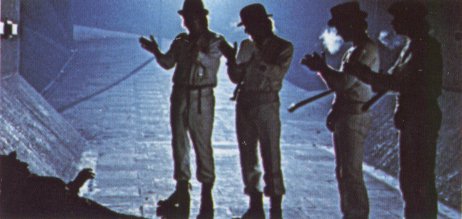
To counter impending economic disaster, major studios often continue to resubmit their films, sequentially making literally only a few seconds' cuts for each resubmission. Films like Basic Instinct, Natural Born Killers, Angel Heart, and the epic 1983 version of Scarface, to name a few, were resubmitted in slightly revised form until all shock value was eroded from repeated exposure, or, at least in theory, until the ratings board, like the teacher of a delinquent child, finally folded and said, "You pass! Gedouddahere. I never want to see you again!" What else could explain the supposed difference that chopping only nine seconds of blood in Angel Heart or thirty seconds of simulated sexual content in A Clockwork Orange made (Svetkey 30)? Or how excising a micromentary suggestive shot of cunnilingus-performing Michael Douglas somehow made Basic Instinct more suitable for children who secured their parents' permission? (Ebert 816).
The MPAA and similar groups assume that all parents are in substantial agreement on the subjects of sex and violence. This reductionistic, formulaic approach replaces the evaluation of an entire film with moral bean-counting. John Hughes' earlier movies often inspired audience members to question how the ratings worked. In fact, the PG rating of his Sixteen Candles caused a few appalled and vocal parents to insist that drug use must never be depicted in a PG film. Hughes' The Breakfast Club, because of a few utterances of what Neil Simon once dubbed "the f-word," was branded with an R.
Admittedly, the ratings board faces an extremely difficult task. "In part," Svetkey claims, "it's an almost impressionistic process, with each member guessing at what an appropriate rating should be," even while following some very specific guidelines (30). It is the qualities of "impressionistic" and "capricious" decision-making which defeat the good intentions of the ratings process.
Seventeen years old is an arbitrarily-selected age for prohibition of film content. We all know kids who can handle Dostoyevsky at age 9 and people who, well into their 20s, can't seem to grasp that Boyz N' the Hood and Menace II Society are not glorifications of "'ho's, guns, 'n' killin.'" Small groups of people who oppose sex education programs or find offense in Huck Finn's utterance of the word "nigger," or who find non-secular overtones in a sci-fi thriller, should not dictate the availability of films -- or any work of art -- for all. Only the adults for themselves and parents for their children should have final authority to decide what expressions of art to consume. Censorship -- the act of forbidding all to consume what some choose not to consume -- is not the answer, either for parents or for the artists. The ratings system should assist that decision-making rather than control it. It should promote active participation of parents in deciding their children's viewing options rather than enabling passive response to a single rating label.
To facilitate this active participation by parents, the ratings board, in addition to issuing its ratings, should provide clear information to parents about the processes used to rate films and the reasons why a given film was rated as it was. Publishing explanations of why the board felt compelled to rate the film as they did would assist parents in making their own decisions. Parents also need to understand that the ratings board provides advice from a small group of individuals at a given point in time. This information will help parents to realize that a simple rating label stamped on a film is not enough information for good parental guidance.
A less impressionistic and arbitrary rating system will also benefit the film-maker, whose artistic choices will be judged worthy or unworthy -- artistically or economically -- by the marketplace of the audiences rather than by a small ratings group and its best guess at what rating will be perceived most acceptable. Publishing the board's reasons and response -- rather than just their summary rating -- will promote dialogue about film content, technique, and the themes film-makers seek to portray. That dialogue would be good for parents, children, other movie-goers, the artists, and the industry alike.
Finally, theatre owners should take a more pro-active role in serving their communities. Rather than acting as parents or ignoring parental choices -- depending on the rating of the film being shown currently -- the owners should seek community involvement in deciding how parental choice will be verified. Perhaps some parents wish to record a "standing" permission for their children to view all films. Some communities may choose to have parental notes checked for all children on all films. After all, even the G-rated The Lion King was offensive to some, who perceived it to be racist or homophobic. This dialogue, carried out at the local level, can promote understanding and support between parents and theatre owners.
Dialogue based on complete information promotes good decision-making. Rather than arbitrary, impressionistic censorship or pseudo-censorship, a collaboration among the film industry, the ratings board, the theatre owners, the parents, and the community will benefit both the art's creators and its consumers.
Fourteen year old John Small's trip to the theatre is an opportunity to experience a world which can inform, entertain, and even persuade him. The more completely examined and discussed the decision to allow his attendance, the more likely he -- and his parents -- can participate effectively in the artistic experience and its effects on him. If the rating system and its implementation are based on dialogue rather than didacticism, on information rather than impressionism, and on the art rather than the arbitrary, the system will serve both its purpose and its public more effectively.