by
I had dreaded this moment for an entire week. But here I was. I exited the
car and followed my mom toward St. Mary's, a Catholic school where she
taught and I attended CCD. As we approached the foyer, my stomach churned.
There he was. There was David Skoalnik, the monster alternately known as
Mongo and Huey-One-Nut, the latter appellation stemming from a rumored
missing testicle. My mother opened the door, and I continued my stride,
knowing that the bloodshed would start only after the adult took her
leave. But I had flattered my opponent.
Two steps into the vestibule, all was a hot flash and translucent
floaters. Mongo had hit me in the back of the head -- in front of my
mother. She yelped and stood before me with tears in her eyes. But there
was little she could do. I'd have to go this alone. The rest of the
students started gathering in the hall, and my mother went off to tend to
her duties. Mongo retreated for a few moments as well. I, of course, took
this opportunity to tell everyone what cheap a pussy he was.
Overhearing my undisguised wails of protest, Mongo arose and Round II was
officially underway. 60 kids enveloped us as we spit and swore. With the
exception of two Skoalnik relatives, all were on my side. Still, I had
never thrown an honest punch in my life and was fairly convinced that this
was not the time to start. Mongo had flunked so many times there was no
telling how old he was and his neck was as thick as Stallone's."Come on,
you little cunt," he lisped. I had to think of a way out.
Mongo -- who outweighed me 2 to 1 -- would never dare take the first
punch. He'd look like a complete asshole if he did. There was only one
way to win. I'd grandstand so bad, he'd have to back down. I'd put him in
the losing position. "You know I'm not gonna hit you," I said. "If you
insist upon punching me, do it. Hit me." He stood before me as I stared
into his eyes. "Hit me." He loosened up, his fist falling to his side.
But what looked like a triumph of reason soon revealed itself to be a
prelude to yet another wind-up. His bleating face became a red tangle of
musculature and flesh. I was soon lost in another flash and emerged from
the darkness on my back, Bob Jefferies hovering over me, checking my
pupils. "I canÍt believe he did that." Neither could I. But the blame was
partially mine. After all, I had tried to appeal to a man capable of
unfurling a cheap shot in front of my mother with pap worthy of
Parents
magazine.
All this because Jefferies thought it would be funny to tell Owatonna High's meanest man that I regularly made fun of him. Of course I did. A freewheeling wiseacre, I never tried to disguise my contempt and consequently spent several mornings being chased through the halls. It all was endlessly amusing and almost too easy. Upon catching up to me, Mongo would halt my antics with a numbing stranglehold until I convinced him that I was sorry and would never tease him again. When his grip relented, I'd continue right where I left off: "Mongo isn't on steroids," I'd say, before neighing and scraping my foot on the tile like a horse. His burn-out friends stared in utter shock, not knowing whether they should gang up on me or instinctively reach for the picks in their back pockets.
School and backyard showdowns occur everyday. Ask any kid. If they're not the ones swinging, they're ducking. I, for one, have always had a nemesis. Long before Mongo, I was doing battle with Jesse Gorzales, a lug they called Percy, and a kid next door who once planted a two-by-four square between my eyes. I also narrowly escaped a horde of drunk high schoolers who eventually captured Ben Borhee and I after a gang of us cracked their jeep with a beer bottle. They kept muttering something about us giving them blow jobs. We eventually escaped, but it's funny how something which was once considered the most serious affront to manhood now only inspires regret. I almost wish they would've gone through with it. Had a cock touched my mouth, I would've bit that fucker clean off and thrown it at the others.
I also tangoed with a man we affectionately referred to as "Sweetcheeks" (a.k.a. Phil Seekor), a towering giant with metal hair and a cleft chin. One minute he'd intently race after you, and the next, he'd good-naturedly slap your shoulder, thinking you were sharing his laughter at a well placed "pussy" taunt. Sure, several people witnessed him hanging frail Peter Nelson upside down over a stairwell with one hand, but I was convinced that stunts like this were merely desperate attempts to preserve his ever-faltering bad-ass image. A guy like this always verges on unintentional self-parody.
Yet John Bolger will forever be my favorite bully, and not just because he and some of his friends were arrested after they dropped out of high school and formed a club called "The Midnight Rockers" (apparently, membership consisted of going out after sundown and throwing rocks through windows). He was one of those kids whose parents treated him like Harriet Tubman. Jane and Roger Bolger didn't have kids because of an instinctual urge to promulgate the species; they spawned because it was a convenient way to assure the completion of household chores. On any given day, the three biological Bolger children and an alternating array of foster kids were forced to scrub the kitchen floor, paint the house, mow the lawn, wash the innumerable dishes, or vacuum nauseating globs of dog hair out of thick shag carpets. A stern whipping was the penalty for any task not satisfactorily completed. Naturally, any person in a position of extreme oppression like this dreams of the day that they, too, will be able to exercise their share of tyranny. Fuck B.F. Skinner and fuck Abigail Van Buren. Stern discipline creates despots.
The Bolger brood was anything but meek, humble, or well behaved. Each child was positively vindictive, John being the worst. "Don't lip off," he'd command. I'd just look up at this a kid who was 4 years my senior and considerably larger and think about the humiliation he must feel when his 300 pound mother bawls him out on the front lawn. I understood why he was such a prick, but cruelty bearing such a facile motive is much more repugnant than that which is inexplicable. I'd rather contend with a foe who can only adequately be described as a force of nature than one who can be summarily sized-up with a paragraph's worth of pop psychology. IÍd just look up at this kid and say, "'Lip off'? Is that even possible? You 'lip off' to your parents. You 'lip off' to bike patrols. You 'lip off' to the man at the pool who only gives you two boxes of Cherry Clans when you asked for three. You 'lip off' to adults. Who are you? The old geezer on the stoop?"
My monologues usually gave way to a nasty series of wheezes. John had a mean right jab.
I suppose there can be no heroes without villains, just as there can be no pleasure without pain, no drunks without teetotalers. Indeed, the history of humankind is a veritable compendium of warring opposites. While revisionists see to it that designation of the terms "aggressor" and "victim" continually flip-flops, it is near impossible to cite a situation where someone is not viewed as "good" and someone else "bad." It's no coincidence, then, that when motion pictures came into existence, they, too, reflected this dualistic sense of the world, just as literature and the theater had centuries before. From Dudley Doright keeping his suit white while foiling the knave who had a train track fetish and a penchant for handlebar mustaches to Luke Skywalker and the Rebel Alliance marshaling The Force against the evil Empire, the history of the cinema has been our history. Political attitudes and formats may alter the particulars, but, be you Bolshevik, redneck, or avant gardist, dramatic structure has always boiled down to one thing: struggle.
Typically, conflict is instigated by an external threat of some sort. When natural disasters are not to blame, these threats manifest themselves as other humans or, at the very least, pseudo-humans, such as monsters or aliens. Gangsters, gunslingers, mentally unstable killers, Indians, and even evil bankers have long been literary and Hollywood mainstays. Even youth fare has always incorporated villains, but, prior to the 80s, the presence of evil was largely archetypal and primarily served to engender a pro-social message. Bungling cheaters and brutalizers were always certain to get theirs. By the time the late 70s and early 80s rolled around, however, things had gotten decidedly murkier. While "good" still managed to save the day, the demarcation between right and wrong began to blur and the stakes grew more severe. Young people prior to the botched Carter and Reagan eras worried about innocuous matters like suffering a dishonest loss at the science fair or being unjustly deprived of lunchmoney. Threats of death were made, but they were generally hard to take seriously, and when someone was killed, it was usually the result of a horrible accident. In teen-oriented films from the 50s and 60s such as The Blackboard Jungle and Rebel Without a Cause, for instance, the ever-present switchblade seems more an emblem of attitude than a functioning weapon which could ever intentionally be used to maim.
A few decades later all this had changed. Cowboys and cops were no longer the only ones engaged in bloody battles so urgent and exaggerated they bordered on the mythic. Now women and children regularly fought for their lives as well.
If you've never heard of this long out-of-print film, you would do well to run to the hippest video store in your neighborhood and steal any copy they've got. This is where it all started, folks. Prior to this ultra-low budget independent's release, nothing had so radically turned the bully genre on its head. While the technical aspects of this film are admittedly embarrassing, its rabid deconstruction of the typically polarized notion of good and evil still stings, even as the existence of hommages and copy-cat films like The Heathers and Ms. 45 work to dilute ultimate impact.
Massacre begins as David attempts to acclimate himself to a new high school in LA, where a gang of jocks terrorize the other kids at whim. One of the brutes -- a preppy named Mark -- was helped out of a jam by David a few years earlier and graciously invites him to join his little club. David declines, instead opting to foment a coup among the downtrodden students while flirting with Mark's girlfriend. When David foils a rape attempted by the brutish gang, they retaliate by crushing one of his legs. Upon recovering, he decides to dethrone the bullies, taking care to make their deaths look like accidents. There is a disturbing electrocution by hang-gliding and a great scene where a baddie dives head first into an empty swimming pool. Having killed all of the goons but Mark, David soon finds himself in the position he loathed before as the weaklings he tried to defend attempt to court favors from their new hero, gather power, and take over the school. Disgusted that the oppressed have turned into their oppressors, David once again, begins to eliminate troublesome students, eventually electing to blow up the entire school.
Curiously, no frame reveals even a hint of an adult. Essentially a contemporary retelling of Lord of the Flies, Massacre chronicles a world constantly verging on chaos. Flux is feared so much, in fact, that social contracts are clinged to even when the stipulations are less than edifying. When stripped of the order decreed by the fascistic regime, the previously victimized characters lose all sense of empathy and morality. The fat and pimpled come to belittle the crippled and the effete. Even our hero becomes suspect. We feel more compassion for Mark during the final fade-out than we do for David. There is a definite lesson here, but it transcends the typical revenge film's rote nose-thumbing of aggression and unmitigated enthusiasm over self-defense. In presenting a finely tuned allegory of societal power structures, politics, and the ultimate failure of revolution, Director Renee Daalder suggests that everyone of us is capable of cruelty. Unless we consciously strive for humanity, very little holds us back from becoming tyrants ourselves. If properly empowered and inclined, we, too, will rape, pillage and kill.
I often wonder how much this film and others like it actually served to shape young bullies. Obviously, people have been harassed since the beginning of time, but when did thugs start saying things like, "You better grow some eyes on the back of your head, 'cuz you won't know when it's coming" or "That's just a love tap compared to what's in store for you"? While one may never know the answer to such questions, one thing is certain: the first half of My Bodyguard is an acute depiction of what it was like to be young and vulnerable in the late 70s and early 80s. Although it is first-and-foremost, a family film, it notably captures several emotions and situations which the other bully movies are too bloodthirsty to notice. There's an almost palpable sense of dread -- even as Dave Grusin's noodely-doodely score plays in the background. No other movie that I'm aware of so convincingly replicates what it feels like to unnaturally postpone exits and entrances in the interest of warding off feared confrontations. It understands that a vacant school can be a pretty frightening place when you find yourself marked as prey.
Most admirable of all, however, is the way the film manages to confront an issue so basic, so internalized by students and their filmic counterparts, that it's existence is largely forgotten. Yes, this is the only film on our list to address the pitfalls of adult intervention. Clifford learns firsthand that you should never let your parents get involved in schoolyard skirmishes. It's not practical, as bullies just get angrier and school officials invariably treat you like a pansy. Besides, it's patently uncool. Consequently, puncher and punchee ascribe to an unwritten rule, a rule which reads, "Thou Shalt Not Narc." The last time I pondered this dictum was back in the 9th grade when Jefferies and I were snapping Sweetcheeks with 8 feet of rubber tubing during science class. Since I had to squeeze into a corner to maximize the tubing's stretch so we could get a suitably painful shot off on our target, our activity wasn't exactly inconspicuous. After the fourth or fifth snap, Mr. Delaitsch busted us. It was obvious that we were in the process of welting the ogre, but Delaitsch asked Sweetcheeks to tell him what was going on anyway. "Nothing, Mr. D. We're just havin' some fun here." Delaitsch's stern demeanor soon twisted into a knowing grin: "Fun, huh?" He knew the rule, too, and wasn't about to break it. Sweetcheeks, Bob, and myself shared a good chuckle.
But when the bell sounded, it was business as usual. Ten strides out of the classroom, I heard a thud and a moan. I later found out Jefferies had taken a blow to the kidneys. I was too busy running to look back.
I remember when I saw this flick for the first time. Like all other fifth graders on the scrawny side, I walked out of the theater with a newfound sense of empowerment, a desire to tell the assholes of the world to fuck off. When I recall this sensation now, I feel nothing but mortification. My fist stopped pumping a long time ago.
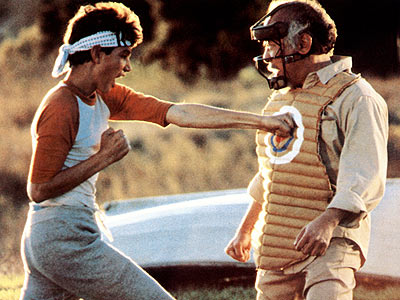
First off, I don't think I've ever met a protagonist who deserves a good beating more than Danny. Before the first reel has unwound, he wears camouflage pants, talks to himself -- "I say she's hot. Definitely hot" -- and is dismissed by a gang of honest-to-goodness nerds after having dirt sprayed in his face by the evil Cobra Chi. His best friend is an old janitor for christsakes. While many find this friendship heartwarming. I find it creepy. But we'll get to that in a moment.
The villains are pretty execrable as well. Their idea of terrorizing people is proceeding en masse on mopeds. And maybe this is peculiar to my old school, but wouldn't a group of guys wearing the same Halloween costume to a dance be considered gay? I laugh every time the young nazis praise their sensei, a psycho who, of course, is also a Vietnam Vet -- my single favorite trend from the 70s and 80s. For being two-dimensional twits, the Chi seem to display a remarkable lack of consistency. How else do you explain leader Johnny's about-face immediately before the credits roll? After losing the big tournament and getting smashed in the face, he turns to Danny -- a pip-squeak whom he hates -- and says, "You're all right, Russo."
Throughout, mentor Miyagi advises that "Karate is only for defense. Fighting solves nothing." What a crock of shit. Trust me, I know. It solves everything when you're on the playground. I used to crack Shane Green on the head with a calculator between classes and it seemed to solve a lot. Despite Miyagi's aphoristic odes to non-violence, the story is hypocritically resolved with -- ta-daaaa -- a fight! I don't know why, but the whole movie made perfect sense in the summer of '84. Now I realize that it's nothing more than vaguely irresponsible fantasy. There's no way Macchio could kick anyone's ass, let alone men who are three times as big. Danny's training -- over half of which comes from books --isn't sufficient in the least. Even if he really could beat Johnny, the Chi would more than likely retaliate by gang-banging him until he bled. When all is said and done, the only probable thing depicted in this film is the ease with which a 120 lb. kid can be shoved to the ground. I guess it's also possible that a cocky Italian kid could come to share some heartrending moments with an old Asian man even after being duped into taking care of his yard, but that's it. That's all.
While maturity renders the central fantasy lame, all is not lost. Several other aspects of the film that were only peripheral before begin to assume a new found prominence. Once gleaned, the movie becomes another experience altogether, a bold, subversive excursion. For all its superficial inadequacies, The Karate Kid will forever have my respect as the first teen bully film to slyly challenge gender paradigms.
When Miyagi is introduced angrily swatting a pair of chopsticks at a common fly, it is clear this man has problems. He mellows out and becomes more amiable after befriending the boy. But something still is not right. While it is tempting to chalk his bizarre expressions and weird mannerisms up to cultural differences, careful examination of his speech reveals a common theme. Miyagi looks at the boy while they trim their respective bonsai trees and says, "If come from inside you, always right," At first, this strange advice doesn't seem to warrant a second thought, but before you know it, Miyagi's pointing to his head and his heart. "Karate here," he says. But he doesn't stop there. He points to his crotch and says "Karate never here." Couple this with "Too much by self not good" and you've got a problem. Miyagi fixes Danny's bike, protects him from whoopings, and gives him an antique automobile. The only conclusion? He is an Asian Sugardaddy, a pedophile. Why else would he insist that Danny exercise topless on the beach and obscenely cackle while spraying him with a garden hose. Yes, wet young Italian ass is on his mind. But there's more.
Things get really strange when Miyagi gets drunk and gazes at a picture of a Japanese woman. Because all is told from Danny's naive perspective, the film never explicitly addresses Miyagi's secret. We already know that he is a witch who can heal wounds with his hands, but nothing can prepare us for his (and the film's) most protected secret. Miyagi, you see, was once a transgendered person. The feminine portrait he weeps over is really a picture of him. Those of us who saw M. Butterfly know how this works. Miyagi doesn't want to talk about it and tells the boy it's a photo of his dead wife, but the alert viewer knows better. Miyagi doesn't dress anymore because it's not practical. He's no longer young. Hair grows in odd places. He doesn't have enough money for estrogen injections and refuses to go through life as a mere CD or TV. Besides, he never really wanted to be a woman in the first place; he merely liked having sex with young men and opportunistically wore dresses and make-up as a way to get into their pants. But the man who once bore a striking resemblance to Susie Wong now resembles Mr. Moto. Well into his 60s, Miyagi finds lavishing young men with gifts a more practical method of luring them into his futon.
Danny, however, believes Miyagi is a lonely chap who tragically lost both wife and child to war. His evidence comes in the form of the witch's words and yellow, tattered newspaper articles. But if a man possesses the ability to instantaneously heal wounds, is the fabrication of a few articles really beyond him? Of course not. He shrewdly plays the pity card, realizing it only draws his objects of desire closer. But he's not omnipotent. Like a vampire, Miyagi needs an invitation. In telling the old man he's "The best friend I ever had," Danny unwittingly agrees to perform sexual favors for his Asian master. While no acts of sodomy take place onscreen, Miyagi's smiling freeze frame fade-out suggests that his cunning machinations will soon be rewarded. One has only to look at Danny's haggard mannerisms and exhibitions of aggressive heterosexuality in Part II to fully comprehend what takes place between the films. We leave Danny as he celebrates his karate victory, but it's only a matter of time before he truly understands what Miyagi meant when he muttered "Smell bad. Feel good."
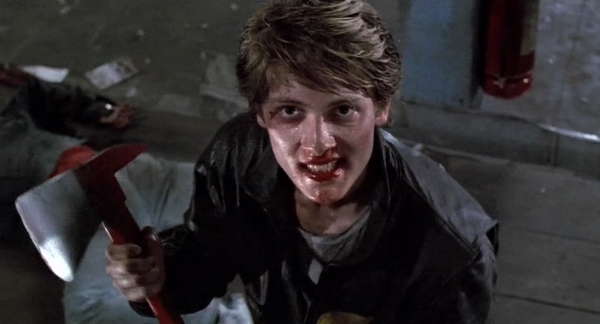
Poor Morgan Hiller (James Spader). The misunderstood wise-acre has been booted from one boarding school to another. His mother never really liked him and his father recently fell from wealth. Now he has to attend a war-torn high school in LA. While his oft-cited past history of trouble goes largely unspecified, there is mention of "rooftop rock concerts between classes." He also has a habit of stealing cars now and again. But any guy who gives his dates books to read, sings romantic ballads with names like "We walk the night" while crashing country clubs, and sprinkles his speech with nuggets of wisdom like, "I don't think you can hold anything until you let it go" canÍt be all bad. He's such a fundamentally good kid, in fact, that he foils a Chicano gangÍs robbery attempt before the credits are even halfway through.
Even after Nick, the leader of the bad guys, vows to get even, Morgan sees nothing wrong with romancing his girl, Frankie, played by the ravishingly developed Kim Richards (she's definitely escaped from Witch Mountain). The film's highpoint is a delirious dance sequence with a hundred or so extras pirouetting around Spader, Richards, and an infuriated Nick, while a band -- featuring a shirtless, bow-tie-clad Downey and pasty faced heroin legend Jim Carroll -- churns out toe-tappable new wave pop. It's one part West Side Story and two parts Rooftops.
Predictably, Spader goes several rounds with the mid-riff crew before a definitive stand must be taken. Never mind that Nick has several opportunities to ice his foe in the ensuing battle royal, but fudges every single one. After 20 or so progressively deadening minutes of continuous skull crushing, pipe swinging, flesh gnawing, and Richards taking more falls than Benny Hill, Downey saves the day with two Doberman Pincers. A series of strewn bandannas, ripped sweatshirts, and blood-spattered painters caps lie in the wake.
The triumphant characters dance with Jack Mack and the Heart Attack in a bizarre curtain call, proving, I suppose, that fighting not only ensures survival, but sometimes even enables one to meet popular entertainers. Musician and actor are intricately choreographed while singing, "T-U-F-F. You're so tuff." Only in the 80s. But what else would you expect from a movie which bears a "Synthesizer Realization" credit?
Less than a year after Tuff Turf, James Spader returned to the screen in a role that was diametrically opposed to his stint as saintly ne'erdowell Morgan Hiller. Donning bleached blonde hair and matching eyebrows, he gleefully chews the scenery as Dutra, the leader of a nasty gang of inbred louts who lord over a small Florida town. He and the clan harass a brother and sister who have left California to live relatives after their folks die. Granted, the miscreants aren't much fun, but they aren't exactly terrifying either. Their misdeeds include ass-grabbing, spitting goobers on microfiche screens, and -- horrors -- budding in line at the drinking fountain.
But bloody mayhem awaits. How could it not with Sean S. Cunningham, the mastermind behind the original Friday the 13th and House in the director's chair? I have to give the movie credit, though, for devising a truly novel method of torture. The inbreds, it turns out, have taught their pitbull to enjoy the taste of blood. They lovingly feed it chicken blood, which means some unfortunate character will inevitably be doused with buckets of crimson before the dog is free to monge on his face. I can truly say I've never seen that before. I also enjoyed watching Spader burn to a crisp at the climax of the big fight, even though he inexplicably gains 65 pounds during his incineration. Either the stuntman was wearing an excess of fireproof padding, or Spader's character is cursed with a nasty thyroid problem, explanation of which ended up on the cutting room floor.
Apart from the previously noted sadistic flourishes, this is a fairly standard revenge melodrama. The New Kids isn't a movie much concerned with twists and turns. The uncle goes through great pains to boast about refurbishing a theme park and his 1960 Caddy, so it is no surprise when both are vandalized minutes later. Still, I honestly can't recall another cinematic experience that had me scratching my head so frequently. When Spader attacks Loughlin in the shower, for instance, are we supposed to miss the fact that she is wearing a bikini? Perhaps she was uncomfortable about nudity and insisted upon being covered in front of the crew, but the bikini appears in the final cut. It would be understandable if the scene took place in a jr. high gym class, but we're talking about a woman taking a shower in her home in the wee hours of the night. And how many times do people in peril have to be reminded that going into an unoccupied bathroom alone is probably a bad idea? It's a mystery to me why a bathroom would be empty during a high school dance in the first place. Furthermore, why would a character go into the john exclusively to fix her hair -- especially when her date is an awkward nerd (Eric Stoltz in his salad days). I'm also still trying to figure out what the line "Soon enough we're gonna be farting through silk" means. But the most puzzling moment of all occurs when Spader fills Loughlin's mouth with lighter fluid and holds a match to her head while attempting to rape her. I'm not trying to be a sleazebag, but what rapist would benefit from such a technique? I guess oral sex would definitely be out, huh? Can it be true that Barbara DeFina, one of Martin Scorsese's key partners, really associate produced this piece of shit?
The brother and sister eventually prevail as we always knew they would, but Cunningham, slave to the slasher formula that he is, cannot resist a final twist. The last shot comes out of nowhere and is impossible to take seriously. As the sappy siblings happily cajole with their relatives at the newly opened carnival, the camera pans to a prepubescent hick boy who had hung around Spader and the gang earlier in the film. Ominous music squeals for a few moments before a putrid pseudo-Loggins anthem chronicling self-reliance kicks in with the credits. I have absolutely no idea what the intention of this final shot could really be. Is the appallingly non-threatening 10 year-old plotting revenge? Or are we supposed to ponder the sociological ramifications of what has happened? Or maybe Cunningham insisted upon a contract clause which would enable yet another sequel franchise. Too bad The New Kids never made more than $2.99 at the box office.
In this dreadful film, a woman, her son, and the always-resented stepfather move from an unnamed city to the backwater Southern town of Granton. What is a boy who hates his wimpy, liberal surrogate dad to do all day? If he's in this movie, he befriends a grumpy old Indian man, who may not know karate, but who can certainly instruct him in the fine art of spear fishing. The boy also develops a crush. Never mind that the girl (Olivia D'Abo) whom he sets his sights upon is the sole female member of the Crow family, a clan that regularly badgers the citizens of Granton.
The baddies actually say things like "Hey, city boy." When they're not out pillaging, performing wild motorcycle stunts, crushing people's hands in vices, or having their powerful hillbilly pa cover for them, they're getting plastered and sticking knives between each other's fingers. The Crow boys are mean foes. Lest we miss the point, geriatrics are the first to grace the body count list. It takes a lot of nerve to open a movie with a man and woman celebrating their 50th anniversary being pushed over a cliff, but it just gets nastier from there. The men of the clan brutally beat the Olivia D'Abo character several times to teach her not to stray from the pack. We're also supposed to be entertained and horrified by the mother continually getting pawed and finally penetrated in a pathetic rape scene a movie of this nature doesn't even come close to earning. I never thought I'd say this, but I think I've finally found a film that has less merit than I Spit on Your Grave.
Aside from being mean-spirited, the whole affair is so predictable, it's utterly unpredictable. Just when you think another highly foreshadowed twist is heading for a pay-off, it never appears (e.g. the old man leaves town toward the end of the film and fails to return at the most crucial moment -- something which is anathema in this genre). You can't even call this film derivative, because the people who made it don't even know how to copy well.
If you do happen upon this wretched mess, be sure to stick around for the howler where the D'Abo goes over to the boy's house and raids his mother's closet to experiment with all things feminine. As anyone who's seen a sitcom or two would expect, the tomboy looks stunning in a dress and make-up. Yet, I found it a tad uncomfortable to watch as the boy drools and gropes. The girl he's making out with, let's not forget, is wearing his mother's hosiery!! I desperately want to believe the filmmakers were goofing on Freud, but there's really no indication that they got the joke.
Ever since Superfly, bad guys who want to go straight experience nothing but trouble from the rest of the world. Adam Baldwin -- an actor who wouldn't have a career without the bully genre -- plays an ex-gang chieftain who just wants to be left alone so he can play basketball and get good grades like all the other kids.
After a series of ludicrous events, however, the gang which he once commanded vows to kill him because of sour grapes. It's rumored that he's narced on the kids during a drug bust. But we know otherwise, because the Cobra leader tells us so in a series of speeches that would infuriate a shrink and anyone who appreciates good writing. "John Hanna was the best guy we ever had in this gang, and I'm not gonna let him get away with what he did. Nobody walks out on Cinco!"
Clearly this movie didn't sets it's sights very high. It's a terminally tepid retread of Tuff Turf, replete with cute Chicano phrases, slutty but sexy girls, and a nerd who steps in to save the hero at exactly the right time. But the final battle is even more protracted and rote than the conclusion of Tuff Turf. Baldwin takes everyone out one by one before facing Cinco. How is it that the head bad guy is always the last to die? And don't these kids ever have homework?
Largely ignored at the time of its release, this is the smartest of the bully films. A nerdy high school kid, Jerry Mitchell (Casey Siemaszko), inadvertently offends a new student, Buddy Revell (Richard Tyson), who has a violent reputation. Revell informs Mitchell that he'll meet him at 3 o'clock in the school parking lot for a fight. We all roughly know how the tale will progress from here, but like the gunslinger sagas and teen bully dramas it mocks, the fun is in the details. The school is an army camp in which the authority figures are either raving Nazis or peaceniks. The students, self-absorbed John Hughes stock types all, don't seem to notice. There's the princess beauty, the token eccentric female, the smart-asses, the A/V geeks, the jocks, etc. This fusion of disparate genre conventions is both original and hilarious. By the time the climactic showdown rolls around, even prison films are given the nod. A piece like this is thirty times better at Po-Mo play than the inexplicably praised Scream, an obnoxiously self-indulgent exercise in deconstructive posturing. Movies that plainly announce themselves to be movies were boring in the 60s and are completely uncalled for now. Viewer's already get the joke; the constructed nature of any media event is a given.
Which is not to say that self-referential humor is not welcome when done well. Scream telegraphs, punctuates, and underlines every reference. If you've never seen Halloween, for instance, don't worry. Wes Craven is sure to integrate the clips being discussed into the story. To have a character explain how sluts are punished in horror films while virginal heroines survive, isn't just obvious, it's extremely old news. Three O' Clock High takes a more subtle tact. The musical theme, for instance, is almost identical to the one in Risky Business. This is far from coincidental, as 60s holdovers Tangerine Dream scored both. There is even an amusing goof on Business' opening shower fantasy. If you get the joke, good for you, if you don't, the movie doesn't leave you cold. The only time High flirts with Scream-style quotation is when the hero and his little sister extrapolate a solution by recounting how Gunsmoke outlaws always throw themselves into jail on the eve of a showdown. What is dumb in Scream is wonderful in High, if partly because the traditional western is now such an endangered and concomitantly unexamined species.
Director Phil Joanou aggressively stages everything with stylish brio. Sweeping camera moves and witty editing abound. But for all the humor and flamboyance, this is a film that gets it right. There are times you can't back down, and once you're determined to deal, you don't need to train a la Daniel-San. Sometimes all it takes is a well placed brass-knuckle to the nose.
The 80s have ended, but apparently teen bullies keep being born. Powder is prime evidence of this. All the thugs come out of hiding when a freaky albino who rarely smiles, but possesses inhuman intelligence, is discovered in his grandparents' cellar. He can trigger extensive electro-magnetic force fields and is blessed with a better memory than the kids in John Ritter commercials. Hell, he can even remember the night his mother was struck by lightning when he was still in her womb. Fresh from years of isolation, he attends school with the other children and experiences all the familiar trials and tribulations. A lonely journey to an unoccupied cafeteria table is a staple of this genre, and so is the baddies' jeering reaction. "They kick you outta cancer camp?" Before you can fully question the marked absence of a lunch monitor, he is forced to hang a spoon from his nose. But our hero, electro-dynamo that he is, forces all the spoons in the room to clang together and suspends the resultant statue in mid-air. If I were a bad guy, I'd probably clamor to befriend this utterly terrifying freak.
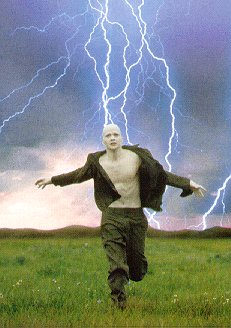
Throughout the course of the film, Powder whines about how he wants to go home so much that had he said it one more time, I would've left the theater, and go "home" he does. But before taking his leave, he inexplicably enters an abandoned school gym out in the country where the town tuffs are playing basketball in their underwear. Powder steals himself into the bathroom where he voyeuristically watches one of the bullies wash himself. It is here that we are mysteriously treated to a tight tracking shot of a water droplet streaking from the young stud's neck down to his bare nipple. Next thing you know, Powder is dragged outside and stripped bare. The bad guys stare between his legs and proclaim his balls to be "bald like a baby." The hairless one also seizes the opportunity to stroke his foe's bare chest. That Victor. What a cad. Even The Karate Kid never went this far.
In addition to the pedophilic subtext, Powder sports an unrelentingly despairing tone. Even if the film too often asserts -- in pop psychology terms -- that the reason people are cruel is because they are scared or insecure, there is a genuine sense of pandemic oppression. Lance Henriksen's sheriff, while sympathetic to the boy's welfare, is preoccupied with his dying wife's health and deteriorating relations with his estranged son. The mean-spirited deputy suffers, too. He's a stupid oaf, but smart enough to be highly self-conscious of his inadequacies, and thus overcompensate with extreme machismo. And in that climactic fight with the young bullies, Powder touches the leader and restores his memory of the abuse games his father used to play out on him. While bullies figure prominently in the narrative, they are no more or no less threatening than anything else in the film. Everyone here is, as Joseph Wood Krutch once wrote, "a flea on the epidermis of the earth."
At the conclusion, Powder is willingly struck by lightning, thus reuniting himself with the earth's energy. The adults in the boy's life, sensing his doomed plight as a mortal, cheer him on as he runs through an open field waiting to get zapped. This new age denouement, I think, is supposed to make us feel good. But how good can one feel when the thesis is how those that are different are better off dead? Apparently, things have grown even more grim in the 90s. Just a few years back, at least in the movies, something resembling good was allowed to triumph over bad. Now only one vestige of those halcyon days remains. The bully leader, however much he may have been subsumed by larger, more pervasive naturalistic forces, still answers to the name Johnny.
Laughable and overwrought as it often is, the bully film is certainly instructive. While the world of the besieged teenager always consists of seemingly insurmountable entropy and peril, the ending is always the same. From My Bodyguard to Powder, the victim transforms himself into the aggressor and resolves his or her plight by giving the enemy a dose of his own drug. But viewed in the aggregate, the bully genre preaches a certain boundless existentialism. Take, for example, how one Los Angeles high school is terrorized by a gang of heavies circa Massacre at Central High, while another is the site of the same conflict 8 years later in Tuff Turf. Yet another Southern Cali school is brought to its knees in 3:15. No victory, it seems, ever completely assures a better tomorrow for either mankind or the individual. Tellingly, many of the same actors are used over and over again. Ultimately, both villain and hero become absurd characters forever waging an endless war.
It is also rather interesting how all but two of the films discussed chronicle the perennial new students' entry into hostile environments. Come to think of it, I, too, was the new kid when Mongo struck. I guess this makes sense. Bullies, like everyone else, get bored. It's no fun picking on the same kid over and over again. New kids afford variety. Furthermore, cruelty is often so prevalent, we sometimes take it for granted until we are thrust willy-nilly into wholly foreign situations. When domination is constant, it is at least possible to develop coping strategies. While the regularly oppressed may experience occasional pain and frustration at the hands of brutes, they are largely complacent. They know what it takes to make it through. They have accepted life's nasty secret: Bullies exist and there's no real escape. Like the non-new kid hero of Three O'Clock High, most of the students in these films and life fail to feel genuine alarm until their own blood is on the line.
While the bully genre revels in violence, it never seems entirely comfortable with it. Even Bullies and 3:15 -- two films which teem with unsavory acts and a decidedly unpleasant air --- serve up a guilty brand of exploitation. Every character and every situation is set up to test the courage of the protagonist in order to find out just how far he will go to protect our culture's greater humanistic impulses. For every villainous act, there is a saintly one to match. But in their steadfast presentation of good and evil, none of these films ever really acknowledge what we all know to be the real root of a good many altercations: Sometimes it's fun to be an asshole. Nothing more, nothing less.
For years, I was the ragdoll who got punched, wrenched, and abused. But there were also numerous moments where I, too, terrorized others until the police were called. A key instance occurred in high school. Bill Meyerson was the class joke, an insecure guy who thought people would find him fascinating if he stretched the truth a tad. After awhile everything he said backfired horribly. Our Paul Bunyan was either completely out of touch or had an insultingly low opinion of his peers. Nevertheless, countless men and women snickered as he told them how he biked up the tallest hill in town no-handed, how the highway patrol are legally required to let you go if they fail to stop your vehicle within 30 miles of the point where they first set their sirens screaming, or how the chemicals in goat milk increase potency while the milk from cows promotes sterility. When he was a senior, word leaked that a disc jockey application he had submitted to the student council was accompanied by a resume and cover letter which boasted about how his well-known "electric" dance moves had earned him the nickname "Rubber Legs." The halls roared with laughter.
But one day, he came to school looking genuinely out of sorts. Meyerson told people that his '77 Thunderbird was stolen, and that when he found it a few days later, his CDs were gone and the ceiling and dash were adorned with messy lipstick pentagrams. Naturally no one believed him. For all we knew, it was just another tall tale. A few night's after the news broke, I was over at a friend's house with a few guys. We began to laugh about Meyerson. Next thing I knew, I was holding a sheet over the phone receiver and rasping about how "The Brotherhood" was going to fuck him up if he continued to tell people of our existence. Meyerson was clearly scared, but maintained a macho front. "Come over," he said. "I've got a surprise for you." I said The Brotherhood would decide when to meet, not him. I hung up, before my friends and I exchanged high-fives.
I had always assumed that Meyerson was lying about the cult matter, but if he had made the whole thing up, why was he taking the phone call so seriously? All these nagging reservations were promptly placed aside as five of us pissed in a jar and slapped it with a label that read, "The Devil's Punch." We placed the concoction on his front door step, rang the door bell, and ran off giggling like schoolgirls. The next day, we all fought to stifle our laughter as Meyerson sat at the lunch table telling us how he saw them gather ant his front door and he was going to stand guard with a shotgun and blow those hooded bastards to shreds the next time they stepped foot on his lawn! Hooded bastards? We were the ones who committed the deed and had no recollection of robes being worn. Clearly, embellishment was still his forte. After school, I borrowed several cloth robes and grim reaper's scythes from my Dad's theater prop room and prepared to deposit yet another jar on his doorstep -- this time a mixture of piss and mayonnaise quaintly dubbed "Satan's Cream."
Our deeds became more extreme as his stories veered even more hysterically off-the-mark. But we didn't want to do this forever. We wanted to hit big and then stand-back. Our final prank was fairly involved, and required a few more players. Now there were 8. We scoured the highway for roadkill and purchased a few big chunks of dry ice at the grocery store. At 10:00, five of us put on our robes and convened in the woods behind Meyerson's house. The other three waited in the wings with engines revving for an efficient getaway. We dumped the dead squirrels into large buckets of water and added the dry ice. 1-2-3. Each person performed his special task. Three bubbling buckets were evenly spaced out in his front yard, while I planted a shitty tape player that blared a medley of howling wind, Iron Maiden's "The Number of the Beast," and the spoken word intro to "Shout at the Devil."
Outside of last year's murder at Bubba's Bar, this is probably the cruelest thing any human in Owatonna has ever done to another person. Needless to say, there was no fighting the ill-advised urge to drive by Meyerson's house to see if our masterpiece had been discovered. When we arrived, Bill's sister stood shrieking in the front yard, her hand over her mouth, bubbling cauldrons filled with bobbing mammals flanking each side. Leave it to Jeff Tanner to awkwardly reverse his car for all to see in the dead end where the targeted house was located. Tires squealed and our caravan proceeded into the night. We were all pissed at Tanner, but not for long. It was a minor glitch. When all was said and done, we laughed until tears wet our cheeks.
At the end of the following school day, I was told that Bill was onto us. It was all over. Everyone assumed that the Meyerson's had run a check on Tanner's license plate number, but since our shenanigans were too good to keep entirely under wraps, word had slipped to a number of people. I'm pretty sure somebody narced on us. To this day, I don't know who the slimy bastard was, and I don't want to know.
We were busted, one by one. Meyerson made the rounds after school, confronting us individually. I pretended not to be home at first, but there was no real escape. Better to talk to him than the police. As far as the authorities were concerned, we were not only guilty for our own harassing acts, but all of those acts which inspired our involvement, including the car vandalism and the stolen cds. All charges were dropped after we apologized to Meyerson, telling him we never meant to torment him. We were just having fun and things got out of hand-- a bold-faced lie. He graciously grinned at our put-upon remorse and shook our hands, part of him perhaps hoping that this would all lead to friendship.
To this day, I have no idea who was responsible for the car theft or the smeared satanic iconography. All I know for sure is that Bill genuinely believes a cult was after him at some point, if only for a brief moment. My friends and I had flirted with genuine danger, and I firmly believe we could have been arrested or even killed by a terminally disturbed Meyerson had the situation not stopped when it did.
The twisted thing is I had a lot of fun and would do it all over again if given the chance.
Mongo and I saw each other for the last time a few years after the CCD KO and just a few weeks after I had finished tormenting Meyerson. A bunch of us frantically scurried into yet another getaway car after we were spotted pissing on Skoalnik's house for laughs. The doors slammed. We were all in and ready to go, but the engine was having problems turning over. Wheer....Wheeeeer...Wheeer. Mongo raised his bat with a medieval groan while streaking toward the car. Wheeeeer, wheeer, whir, whir, whir. All systems were go. The car began to putt ahead, but Mongo came to a sudden halt. He still could've whacked a dent into the vehicle or smashed some glass, but he just stood there. He wasn't doing a goddamn thing. I moved closer to the window and noticed that he was staring straight at me. I gazed back. Even as the Pinto screeched down the road, we continued to size each other up with unbroken eye-contact.
His static figure shrunk in the rearview mirror as we headed downtown. He pressed the bat to his chest and silently watched us drive away. I detected a trace of sadness, an impotent frustration in his low-slung shoulders and felt a tinge of remorse. Mongo and I, it seemed, were together at last, lost in the meager truth of that final confrontation. For a fleeting moment, we both fully understood that no one is exempt from piercing degradation or sadistic exhilaration.
It's all just a matter of timing.